Travel policies for UAE companies: The complete guide (2026)
What is a corporate travel policy?
A corporate travel policy is a formal document that defines how employees book, conduct, and expense business travel on behalf of their organization. It establishes rules around approved booking channels, spending limits, reimbursement procedures, duty of care obligations, and acceptable conduct — giving both the company and its travelers a clear, shared framework.
For companies operating in the UAE, a well-written travel policy does more than control costs. It ensures compliance with local labour law, aligns with VAT reclaim requirements under the Federal Tax Authority (FTA), and reflects the unique travel patterns of a business hub where executives routinely fly between Dubai, Abu Dhabi, Riyadh, Mumbai, and London within the same week.
Without a policy, companies bleed money through inconsistent bookings, missed VAT recovery, uncontrolled upgrade spend, and slow reimbursement cycles that frustrate employees. With one, finance teams gain visibility, travellers gain clarity, and the business gains control.
Why UAE companies need a tailored travel policy
The UAE has a distinct corporate travel landscape that generic, Western-facing templates simply don't address. Several factors make a UAE-specific policy essential:
Geographic reality. The UAE sits at the crossroads of Europe, Asia, and Africa, meaning business travel is not a quarterly event — it is a weekly operational necessity for many organisations. Emirates, Etihad, and flydubai operate hub-and-spoke models that give UAE travellers access to over 200 destinations, which creates both opportunity and complexity when managing preferred airline agreements.
Multi-national workforces. UAE companies typically employ staff from dozens of nationalities. A travel policy must account for passport-specific visa requirements, countries where employees may face entry complications, and varying expectations around travel comfort tied to cultural backgrounds and seniority.
Labour Law compliance. Under UAE Federal Decree-Law No. 33 of 2021 (the UAE Labour Law), employers have defined obligations regarding employee welfare during travel, including duty of care provisions. Your policy should be consistent with these obligations, particularly around travel insurance, health coverage abroad, and working hour expectations during transit.
VAT reclaim. Since the UAE introduced 5% VAT in 2018, businesses can recover input VAT on qualifying travel expenses such as hotel stays and certain transport costs. Your policy must require VAT-compliant receipts (tax invoices) for all UAE-incurred expenses, or you leave money on the table with every trip.
Expense currency complexity. Employees travel to countries across every major currency zone. A clear policy on currency conversion rates — whether to use the Central Bank of UAE rate, the card rate, or the rate on the date of transaction — prevents disputes and manipulation at the expense report stage.
Core components of a travel policy
Scope and Applicability
Define who the policy covers. Most UAE companies apply their travel policy to all full-time employees, but you should explicitly state whether it covers part-time staff, contractors, freelancers on company assignments, and board members. Also clarify whether the policy applies to domestic UAE travel (Abu Dhabi–Dubai, for example), GCC travel, regional international travel, and long-haul intercontinental trips — as each may have different thresholds and rules.
Travel Approval Workflow
Establish a clear approval chain before any trip is booked. A typical UAE corporate hierarchy might require:
Line manager approval for domestic and GCC travel
Department head approval for regional international travel (Asia, Africa, Europe)
C-suite or CFO approval for intercontinental long-haul trips or trips exceeding a defined budget threshold
Specify how approvals are given — whether through your ERP system, a travel management platform, or email — and define lead times. Requiring 72 hours notice for regional flights and five business days for long-haul trips helps your travel desk or TMC (Travel Management Company) secure better fares.
Booking Channels and Preferred Suppliers
A UAE travel policy should mandate the use of approved booking channels to maintain visibility, control, and supplier contract compliance. Options commonly used by UAE businesses include:
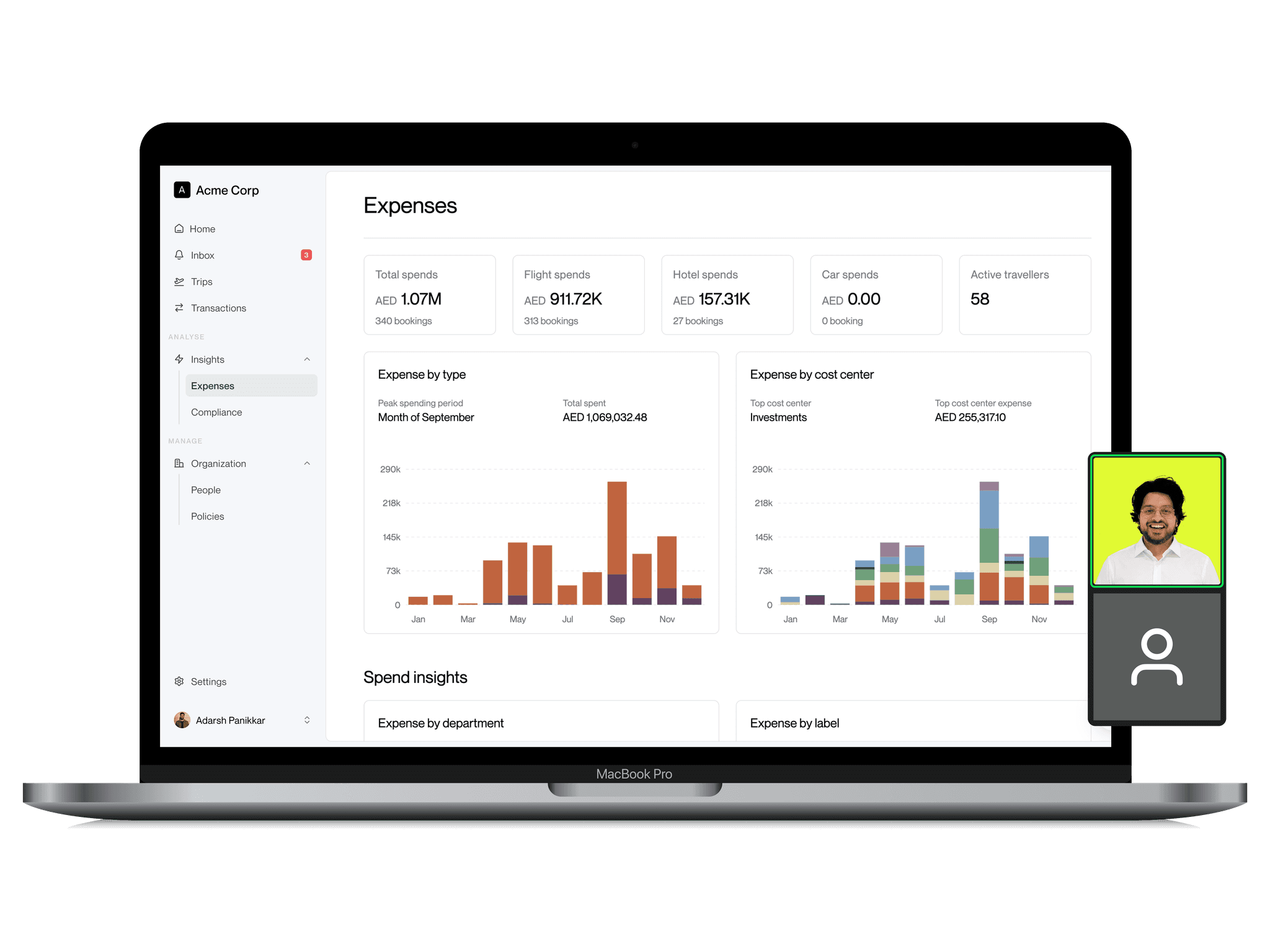
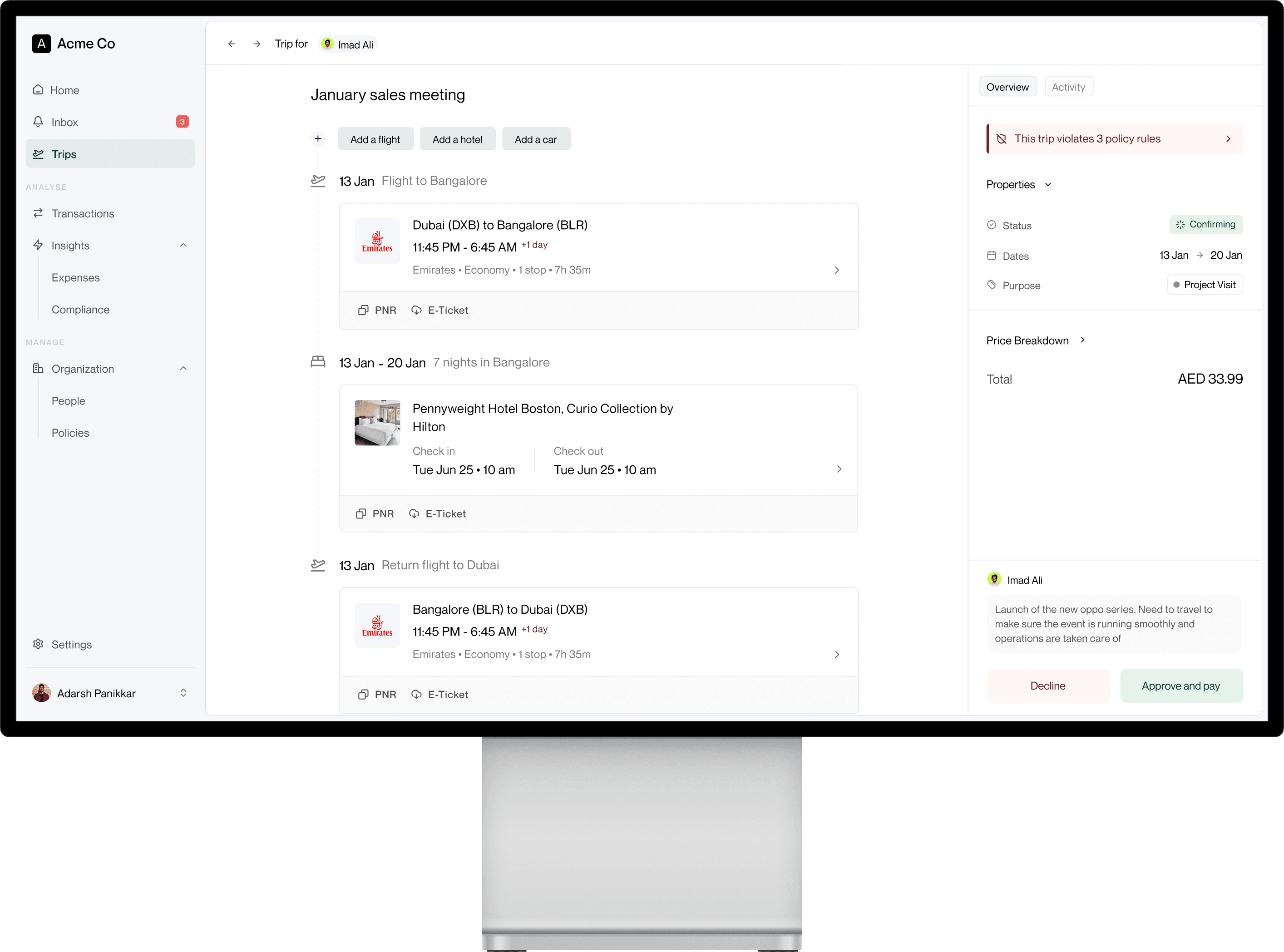
Modern corporate travel platforms, like Kitt - that are purpose-built for UAE companies, easy to set up, and give you all the tools you need to manage business travel - global inventory across flights, hotels, and rental cars, in-built travel policies, approval workflows, centralized billing, and fast human support when things go wrong.
Enterprise Travel Management Companies (TMCs) such as SAP Concur, American Express GBT or FCM Travel - great for very large enterprises with thousands of employees across multiple geographies. Expensive to setup and maintain and overly complex for 99% of UAE companies.
Consumer Booking Tools like Booking.com or Expedia - which offer great supply and booking experience, but no control for finance teams and inconsistent support for travelers on the road.
Booking Class Entitlements
Setting rules for what type of travel can be booked is open to interpretation but most companies globally follow the following parameters-
Spend Limit - The maximum total amount an employee is authorised to spend on a single booking.
Booking Lead Time - The minimum number of days in advance a trip must be booked before the departure date. The earlier a booking is made, the lower the fare typically is, so lead time rules exist to prevent last-minute bookings that carry a significant cost premium.
Class of Booking - The flight cabin class or hotel star rating allowed. This is a simple way to create cost control while booking travel, however given the hundreds of flight, hotel and car rental options available nowadays, this by itself is not sufficient for cost control.
Price Cap - A hard ceiling on the cost of a specific travel component — most commonly a single flight ticket or a nightly hotel rate.
Given below, is a sample travel policy created on Kitt. Our modern business travel platform allows you to set rules once, and then auto-enforces them as employees book - so your finance and HR teams are always in control of spend. Your company moves faster while saving money on every booking!
UAE VAT recovery on travel expenses
Under UAE VAT law, businesses can claim input tax credit on travel expenses that are directly related to making taxable supplies. To do so:
Hotels, transport providers, and other UAE suppliers must issue a proper Tax Invoice (not just a receipt) showing the supplier's TRN (Tax Registration Number)
The expense must be business-related and not fall under blocked input tax categories
Receipts must be retained for 5 years as per FTA requirements
Your policy should explicitly instruct employees to request tax invoices (not regular receipts) for all UAE-incurred expenses and flag that reimbursement may be withheld if a compliant invoice cannot be produced.
Of course, with travel platforms like Kitt, VAT-compliant invoices are automatically generated every time you book!
How to Implement Your Travel Policy
Step 1: Audit Current Spend
Before writing a policy, pull 12 months of travel expense data. Identify your top 10 destinations, average ticket and hotel costs, most common booking lead times, and any patterns of non-compliance or high spend. This data shapes realistic caps and identifies where controls are most needed.
Step 2: Get Cross-Functional Input
Involve Finance (cost control and VAT), HR (employee fairness and Labour Law), Legal (duty of care and compliance), and a senior traveller from the business (practical workability). A policy written by Finance alone without traveller input often fails in practice because it doesn't account for real-world constraints.
Step 3: Select a Travel Management Solution
For companies spending over AED 500,000 annually on travel, a modern travel platform like Kitt is necessary to control costs, or else you risk being blindsided by travel costs. Kitt is an all-in-one travel platform designed for UAE companies - built with global inventory, built-in travel policies, approval workflows and VAT-compliant invoices.
Step 4: Communicate and Train
A policy that exists only as a PDF attachment in an onboarding email will not be followed. Run a launch session, post the policy in your HR portal, include it in onboarding, and send an annual reminder. Ensure line managers understand the approval workflow. Or better yet! Onboard a travel platform like Kitt that automated your travel policy end-to-end without the need for manual enforcement.
Kitt's business travel platform automates travel policy compliance without slowing teams down
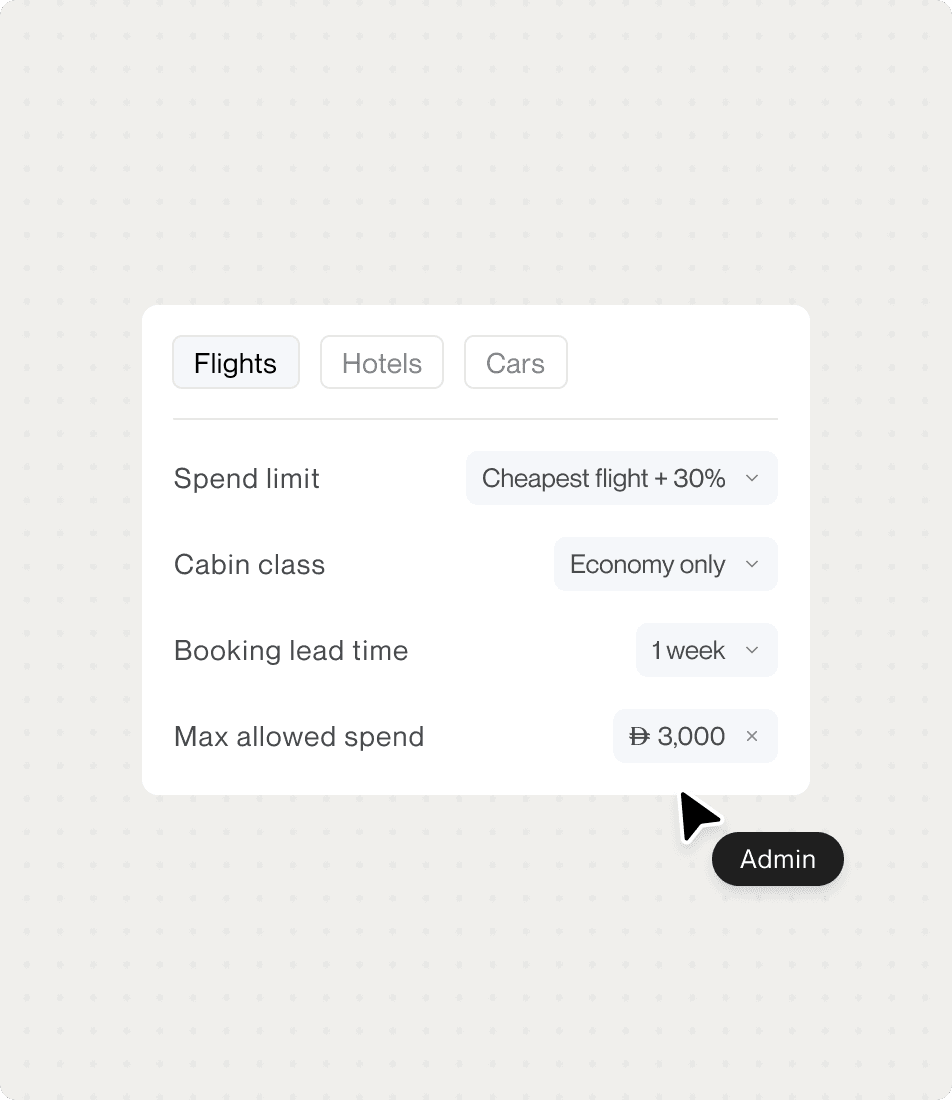
Define the rules. We enforce them.
Define spend limits, cabin classes, booking windows, and approvals once. Kitt applies them automatically at booking.
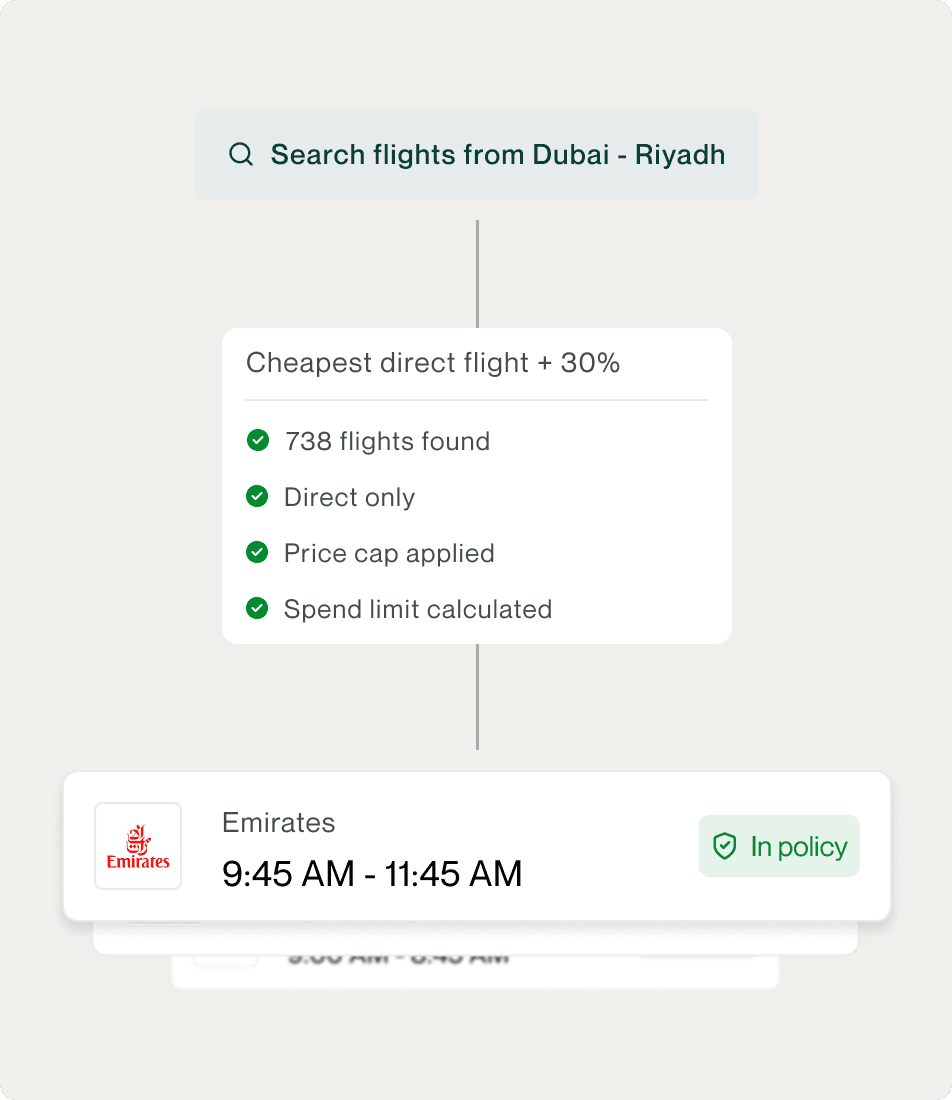
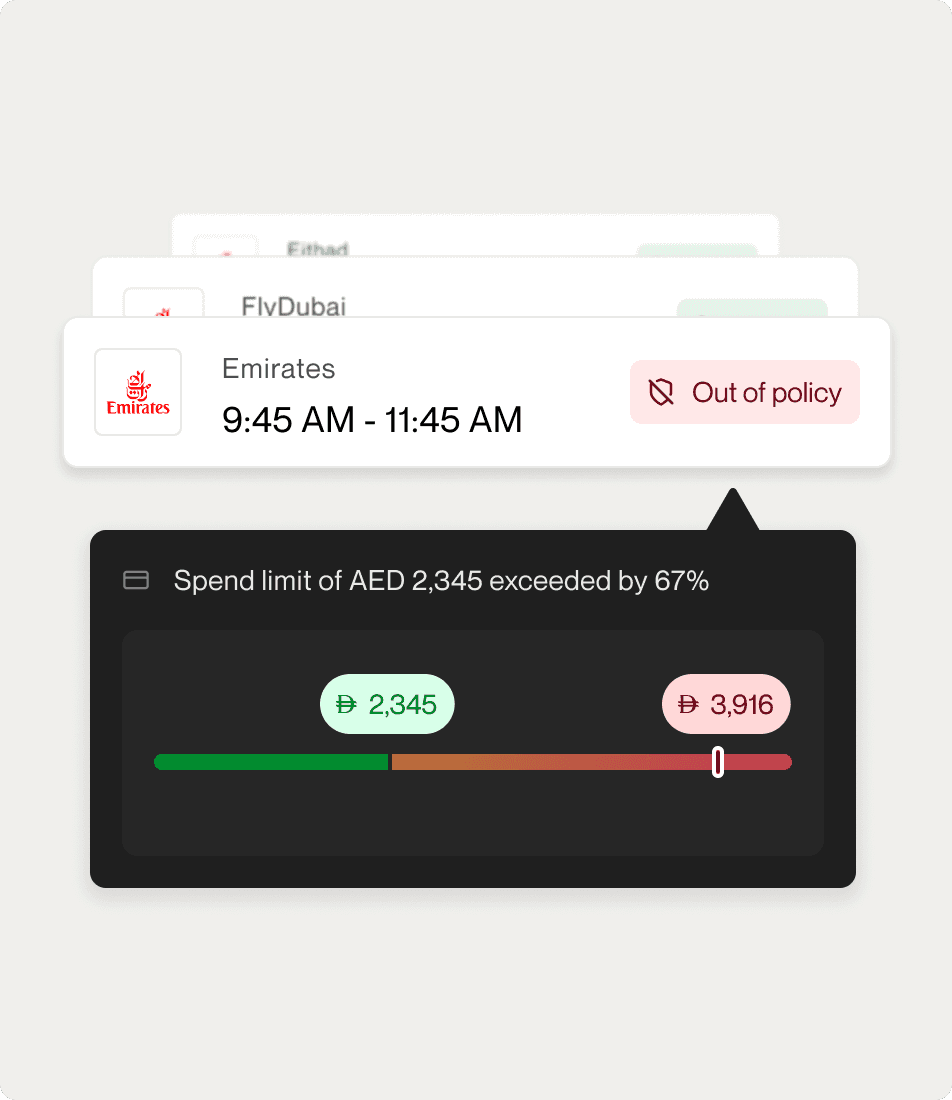
Smart spend limits that adjust to every search
Each search scans live inventory and sets a fair spend limit based on your rules, routes, and timing — not static caps.
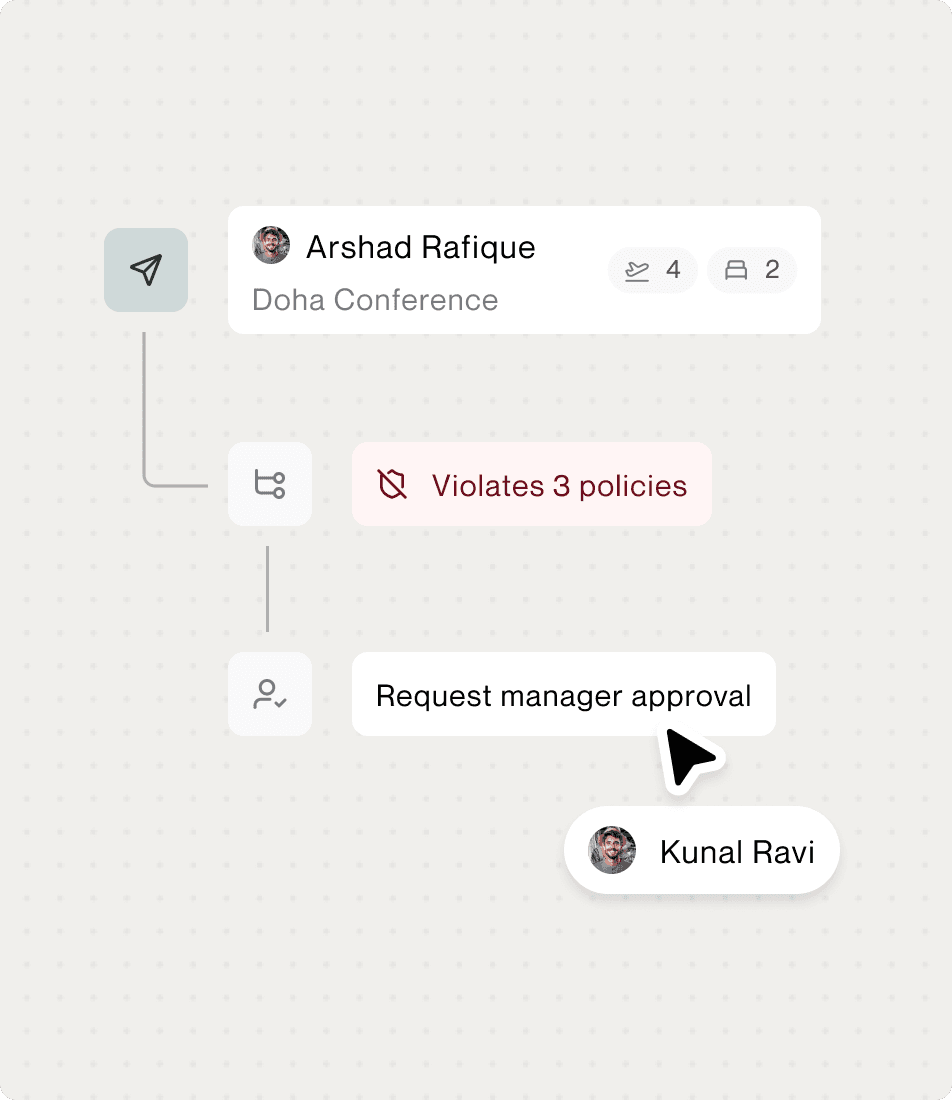
Custom approval workflows, your way
Set flexible approval flows by team, role, or spend — Kitt routes each trip automatically based on your rules.
Control without micromanagement
Policies run quietly in the background, so teams move fast and finance stays confident — without reviewing every booking.

Frequently Asked Questions
What is a corporate travel policy?
A corporate travel policy is a document that defines how employees should book business travel. It usually includes rules for flights, hotels, expense limits, approvals, and reimbursements.
Why do companies need a travel policy?
A travel policy helps companies control travel spending, ensure compliance with company rules, and simplify expense reporting for finance teams.
What should a travel policy include?
Most travel policies include rules for flight classes, hotel budgets, car rental budgets, booking processes, approval workflows, expense reimbursements, and per diem allowances.
Can small companies use a travel policy?
Yes. Even startups benefit from having a simple travel policy because it prevents travel spending from becoming inconsistent as the team grows.
How often should a travel policy be updated?
Companies typically review their travel policies once or twice per year, especially if travel volumes increase or budgets change.